
September 26, 2025
Interview with Rufus Nwoko
Sharon: Before we dive in, here’s a fun icebreaker. What’s one thing you absolutely can’t start your day without?
Rufus: Prayer. I can’t start my day without praying.
On Family Legacy and Design Philosophy
Sharon: Growing up in a family rooted in architectural innovation, how have your grandfather's philosophies — especially around natural synthesis, indigenous materials, and social responsibility — influenced your worldview?
Rufus: Honestly, I didn’t realize the significance until secondary school. I grew up surrounded by it, but I wasn’t paying attention — TV, games, and the internet were distractions.
That shifted when I moved to Ibadan. Suddenly, I was immersed in natural aesthetics. That sparked my curiosity, and from there I began asking questions, learning, and working.
At first, I was drawn to aesthetics. But I later realized that design is functionality first, then aesthetics. Today, everything I do is rooted in that order: how things work before how they look.
So, I made the shift: I began to see design as being about functionality first, then aesthetics. Everything I’m drawn to or that I do now is rooted in functionality — how things work, not just how they look.
Sharon: Thank you. Next question — are you personally involved in any architectural or conservation projects within the family legacy or beyond?
Rufus: I mean, now it’s by choice. When I was younger, it wasn’t necessarily by choice — not that it was forced, but I didn’t really understand why I had to learn certain things. But over time, all of that helped.
Now, yes — I’m involved in some projects within the family and also outside of it. I wouldn’t say I’m actively an architect, but I do see myself as a designer. I understand the importance of creating — and creating with functionality in mind.
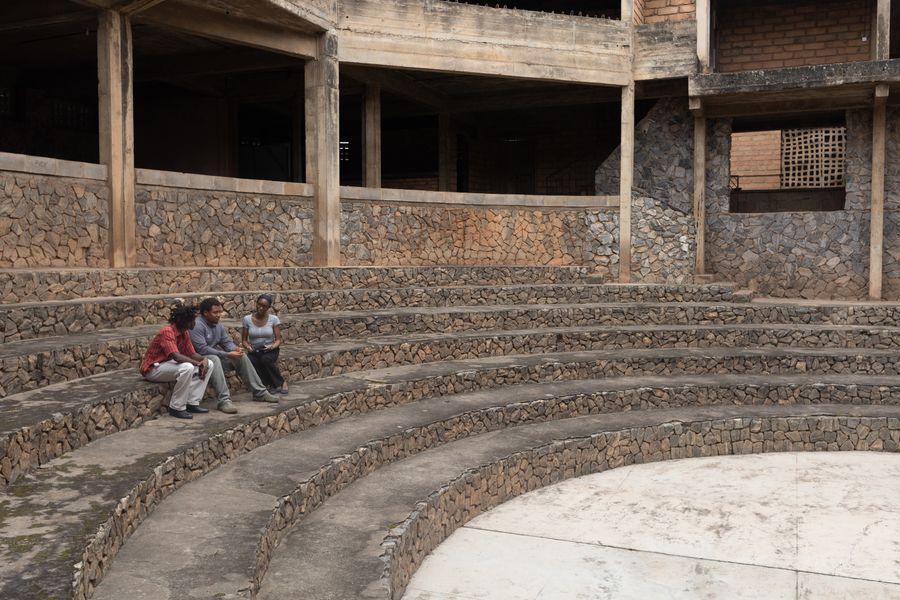
Photo by Adefolarin Adegboye
Sharon: So, you've been involved in digitizing and restoring New Culture Studio. Can you walk us through the most surprising or memorable discovery from the archive?
Rufus: I think what surprised me most was just how intentional my grandfather and his colleagues were. Everything they did was deeply rooted in a narrative — the idea that being African means being a complete creator, from beginning to end.
That philosophy required knowing a bit of everything — not just for the sake of knowledge, but for the purpose of creating. So you’d find that it didn’t matter what someone studied. You could study Fine Arts and still end up working as an engineer, simply because what you wanted to build needed that engineering knowledge.
It just kept going like that — they were constantly learning, constantly expanding their skillsets — all because they wanted to create something truly complete and grounded in purpose.
Sharon: How are you envisioning New Culture Studio evolving — either as a heritage site, an educational space, or a living art space?
Rufus: Living art space doesn’t have to have two parts to it. Maybe for me, I see New Culture Studio as a space — as a space, full stop. Just because of how, you know, contemporary art has evolved from the olden days.
You're talking, you know, pre-colonial — where it was just strictly inspired by culture, you know, by itself. And then now, there’s now the whole need to do it beyond just cultural practice — but also now for the sake of other things like, you know, indigenous practice, innovation, even entertainment now as well.
So New Culture Studio is just that space where you have to express yourself, express the craft — any form of art — and it accommodates that. So yeah... just a space.
Sharon: Okay, I saw you engage in photography and theatre...
Rufus: How?
Sharon: So, like — we went through your work. Social... out there, social media. We saw you engage in photography and theatre. So what other themes or narratives are you drawn to, and how do you see photography complementing your creative projects?
Rufus: Other things I’m drawn to are still within that visual aspect — like film. Film as well, which I guess is just another side of myself that I’ve always wanted to explore.
But then, my type of photography — I don’t know if it has a name — but I like to call it figurative representational work. I deal a lot with nostalgia.
When I want to have a shoot on something, it usually means I have to either create a sort of costume, or I have props — which eventually makes the whole setup become an installation. But at the end of the day, there’s a story behind it. And that story is usually about nostalgia, the same thing — family.
I talk a lot too, so I had to have something I could throw that energy into as well. So then came theatre. That was the only logical explanation.
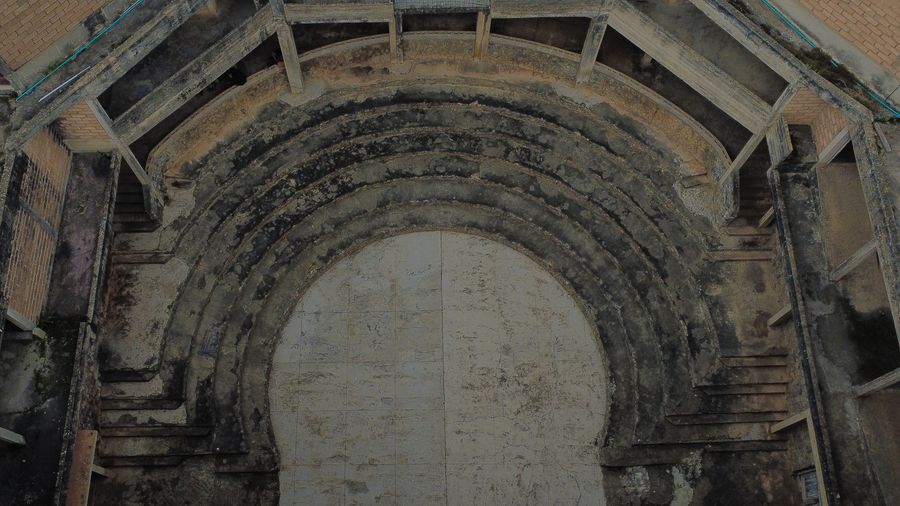
Photo by Adefolarin Adegboye
Sharon: So how do you balance objectivity with emotional or familial connection in your photographic work?
Rufus: I actually don’t. I actually don’t balance it. Because I feel like my whole ideology is a work in progress.
When I feel like something — maybe one or two things — are missing, I still leave the work in that state. Then, I take the correction and add it to the next project. I don’t go back to change it — so that someone else can also see and realize the mistake I made, and maybe learn from that mistake, instead of me trying to correct it.
Sharon: Okay, do you have plans to continue collaborating on material-based projects? If so, what possibilities excite you most?
Rufus: Yes, I do.
I think I’ve massively explored laterite and weather — still at it — but now I’m looking at wood and bamboo. Just for the sake of reinventing acoustic experiences in indoor spaces, so that we can create sustainable designs for natural acoustic experiences without spending so much money on, you know, gadgets.
Not that gadgets are bad or anything — but again, I like to think about affordability. Affordability attached to sustainability as well.
So yeah — wood and bamboo are some of the new materials I’m exploring. Especially now that wood is being treated like a luxury material, which shouldn’t be the case. We abandoned wood and went for plywood boards and MDF — and now we’ve seen that those don’t last more than 5 to 10 years. And 5 to 10 years is not long. You end up running back.
But now, wood has been taken up again as a luxury material. So yeah.
Sharon: Your grandfather was deeply involved in stage design and theater direction early in his career. How has that shaped your own engagements with performance arts?
Rufus: So that goes back to, you know, my first—first thing I said, you know, my first relationship with New Culture Studio. I realized that aesthetics has its own culture.
And when I went through listening to stories of when he jumped into stage design, which he decided to call it Applied aesthetics, that means that he was working from a function through esthetic culture — intentionally placing, you know, visual representation of, you know, of a mode of a performance, or a certain performance, to catch the attention of the audience beyond just the performance of, you know, the actor.
So that after the play, there will also be a reason to stay back and look at, you know, the stage — just based on that Applied aesthetic that you put there.
So the only thing about that was that the functionality was for visual appreciation, which makes sense. And I think it has just been a part of my practice in theater as well. I always make sure that my—my stage setup does give an aesthetic beautification, so that the audiences would want to interact with the stage after the play — sit down, take some pictures, and whatever the case may be — instead of just clapping for the actors.
Sharon: What do you see as your main mission in carrying forward the legacy — whether in theater, archives, architecture, photography, or design?
Rufus: Create something. Make something. To do anything for our survival.
I guess that’s the same thing. That’s the goal.
I’m not trying to fill into anybody’s shoes — those are actually very big shoes. They should stay big. I’m just trying to do my thing and be part of an ongoing history.
New Culture Studio’s legacy is not a one-person legacy. That was never the plan. That was never the idea.
In fact, if that was the idea, it would’ve just been named after one person. But New Culture is about the relationship between the space and the community around it.
In the long run, it’s just about continuing to create — and allowing other people from other communities to come in and create too.
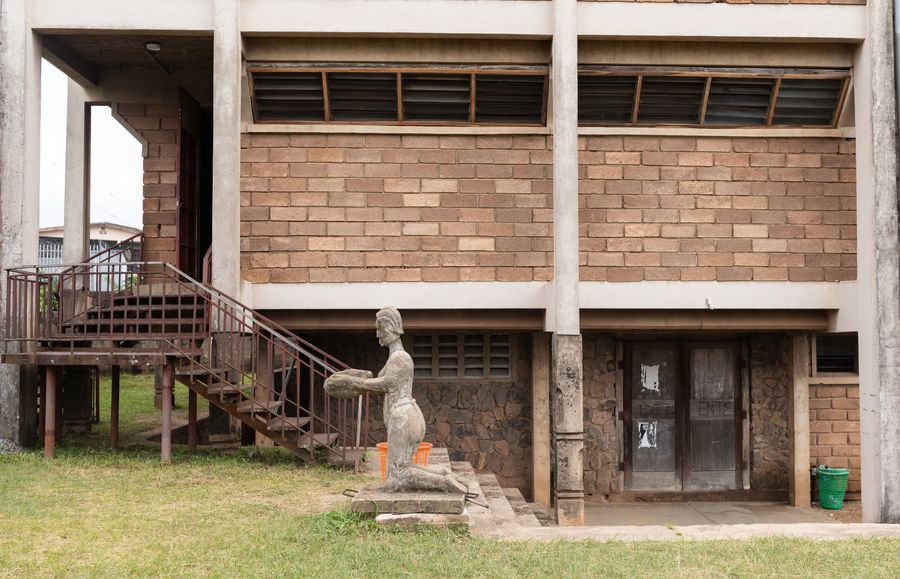
Photo by Adefolarin Adegboye
Sharon: Looking ahead, where do you hope New Culture Studios — and your work — will be in five years? What audiences or communities are you seeking to engage?
Rufus: My local community.
I like to call it the Local Champion Movement. There’s nothing better than being a local champion — and by that, I mean getting appreciation for what you do from your own community.
Because the day you decide to take a step — I won’t even call it a bold step, it depends on you and the kind of appreciation you want your work to receive — but the day you go outside your local space, you already carry a kind of confidence.
That noise from your community is backing you. So when you enter a new country, a new space, people there have no choice but to be curious: “What’s the noise about? What’s the hype?”
And even if it’s just two or three people in that new place — if they catch on — they join the growing wave that started from home.
So, for now, I just want to keep impacting my local community. And then... we’ll see how it goes from there.
Sharon: At the intersection of tradition and innovation, how do you strike a balance between honoring the past and pioneering new cultural expressions?
Rufus: History. Knowing our history.
One of the problems I had — and why it took me a while, from when I was born till much later — was because I just didn’t know any history.
And you know, Africans — we’re natural storytellers. That’s the only way we truly passed on our history.
Other mediums like text, photography, and video are there, yes — but at the end of the day, true African history is passed on through storytelling.
It’s not like my granddad or my dad didn’t want to tell me — or tell us, because it wasn’t just me. I’m speaking generally now — my siblings, my cousins. We all knew our history existed, but we didn’t feel that connection to it at the time.
Even the same goes for my colleagues — the team behind the success of what New Culture Studio is today.
During this restoration process we’re doing now, the moment we all knew our history, there was a general understanding. Something just clicked.
And from that point on, we knew the importance: That what happened in the past still has to happen in the present — it still has to live on.
That’s how you continue to pass on legacy, tradition, and everything else that matters.
Sharon: What is one favorite, overlooked work by your grandfather — and why?
Rufus: The Dominican Chapel that he built.
It’s massively evaluated — heavily. That was his first professional contract, and everyone thinks it’s his best work. But the thing is, that kind of thinking puts him in a box.
And he’s not a guy that fits into a box. He’s multi-dimensional.
Yes, he created that powerful statement with the chapel — but he’s also Demas the designer, Demas the actor, Demas the writer, philosopher, researcher… all of that.
And without seeing those other sides, you don’t fully understand him.
So yes, I see the chapel — but at the same time, I don’t only see it. Because I’ve seen a lot more.
Some of his best works are actually hidden. I’ve put some up on my Instagram page before, and people are like, “Oh? Where is that? When was this?” And I’m like — that was very beautiful.
But people just haven’t seen them.
Sharon: New Culture Studios seems to function as more than just a performance venue. Can you walk us through its various spaces and what they offer artists and the community?
Rufus: The visual institution — we have a library and a classroom, we have office space, and we also have living residency quarters. We have a bar, and then even a proposed site for a restaurant and lounge, the co-working space, and a café.
So if you look at it, that's the general idea of what a hub should be. But then now, patriarchs — I hope it's not tentatively — it's not just a building. It's a building with intentional functionalities for the artist to create convenience.
Sharon: There’s a very deliberate choice of materials throughout the building. Can you speak to the philosophy behind those decisions?
Rufus: My grandfather intentionally used the materials as a rebellion against Western industrialization on architecture. We had a problem of abandoning our traditional materials. He wasn’t against cement — it’s not like cement was bad — but as Africans, we were meant to adapt cement with our natural materials, which is the rocks and red earth.
So now these red bricks are 80% laterite, 20% cement. Cement is the bonding agent.
That means the block is stronger than mud houses, but it still functions the same — it insulates, it takes heat, converts it into coolness on the inside. You’re just building an industrial, modern version of mud houses. Still the same functionality.
Sharon: How does this architectural thinking extend to sound and performance?
Rufus: Stone walls help with structure, but for a performance space like this, my grandfather needed the perfect acoustic materials. And he found out that stone walls were better acoustic materials for a capacity like this than wood.
If it’s overused, wood becomes more of a sound-dampening material, not an absorber.
Stone walls, they don’t dampen inside. They absorb the sound and give back. And that’s why he laced it everywhere — so we can have a performance here and the actors don’t need a microphone.
You can test it. I can stand at center stage and talk, and you’ll hear it at the back. That’s ancient technology.
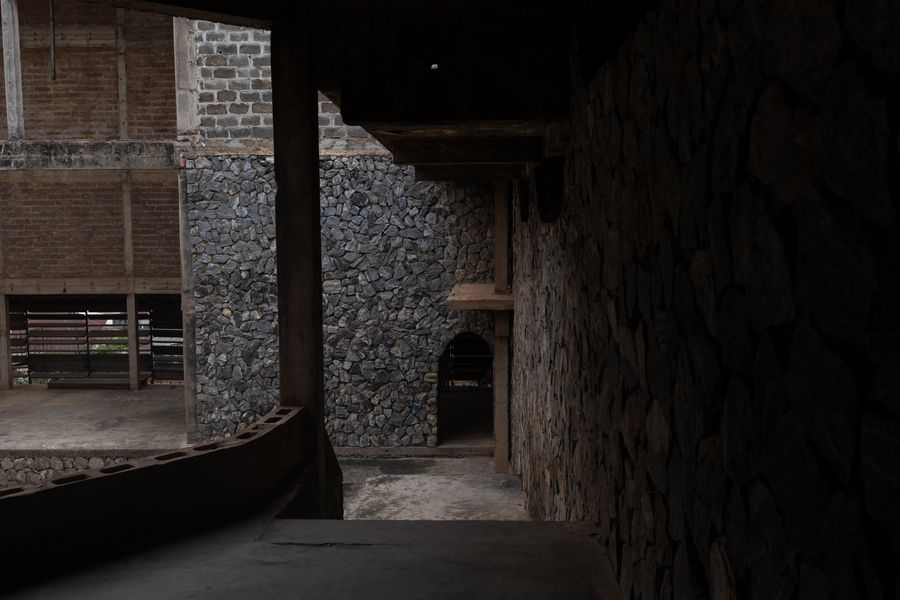
Photo by Adefolarin Adegboye
Sharon: I’ve noticed buildings like this often leave the red bricks unpainted or exposed. What’s the intention behind that?
Rufus: That’s just the red brick. It’s a style of laying blocks. When it’s not mortared like this, it means it’s to be plastered or covered with something else.
But when you design for functionality, you don’t need to apply anything — it already has natural aesthetics.
If you need to add something extra, that’s what we call applied aesthetics. You’re adding features not for functionality, but for beauty.
Some people come and say, “Paint this wall,” but others appreciate it — the way it ages with time. Plus, it means low maintenance. No need to worry about painting — just scrape and clean. And if you want, that’s where innovation comes in: you can coat it with epoxy — waterproof, easy — and you’re good.
Sharon: That’s a beautiful merging of form and function. Do you open up the space for people to experience these design choices?
Rufus: People should come for one of my tours. Check my Instagram. We do tours. Not monthly... maybe one will happen soon.
Sharon: Why is it important to create a platform like this in Ibadan, and what role does affordability play in that vision?
Rufus: That much exposure and experience — like you have in Lagos — we don’t have that here. Lagos is commercially advanced. So why not bring that experience here?
It’s really just an encouragement and empowerment scheme, so we can motivate our creatives to stay back in Ibadan and give our audiences original content too.
Instead of always waiting for content to come from Lagos — and yes, we’ll still get great content from there — we want to also match that energy and even produce better work from our local artists here.
But the only way that can happen is if there’s a platform that encourages them to keep creating and doing more.
Because if you want to go to a hall outside of here, apart from this space, they’ll charge you maybe a million naira. That means your budget is already high — and most of it is just going to the venue.
But here, if you want to do a musical showcase, exhibition, stage play, whatever — you’re saving a lot.
In most cases, you’re not spending that much on the space. So now you can rechannel your budget into other things that improve the quality of your production.
And who knows — you sell tickets, and you’ve not only financially appreciated your product, but maybe even made enough to take it to Ghana or beyond. Especially for stage plays — I see this as an empowerment scheme. Maybe it’ll remain that way for the next 20 to 50 years.
Sharon: That’s a strong commitment to community. Why Ibadan specifically?
Rufus: Because Ibadan needs it. No one else is doing this here.
You can’t try this in Lagos. Even if you wanted to — it just takes one powerful person to kick you out.
People come here and say, “Ah, I can turn this place into a club.” And I’ve been to clubs — I understand the vision, but… why?
Sharon: So collaboration has been a key part of keeping the vision alive?
Rufus: 100%. Once you start having so many communities coming together, that’s when self-funding and resource exchange begin.
That’s why collaboration is important. There are things we don’t have money for, but maybe one of our guys already has it — and that’s how we’ve been able to do so much.
As much as we’d love to get funding — and yes, funding is important — we can’t sit around waiting for it.
We have to start. Just like Grafiki, you guys are an independent body — and some form of self-funding has to happen for it to begin.
This is that self-funding strategy. We’ll see how it goes. But yeah — if anyone has plenty, I’m here. (laughs)
"New Culture Studio" Cover Photo by Adefolarin Adegboye